The Rise of Regional Think Tanks: Knowledge Diplomacy and Policy Dialogue in Eurasia
The concept of think tanks as actors of knowledge diplomacy has gained remarkable traction in Eurasia over the past decade. Once peripheral to policymaking in many former Soviet Union states, regional research institutions have now emerged as central platforms for translating expertise into regional cooperation, statecraft, and soft power. This trend reflects a deliberate effort by Eurasian states to cultivate epistemic infrastructure linking domestic expert capacity with international policy debates and to project influence through intellectual exchange rather than coercion.
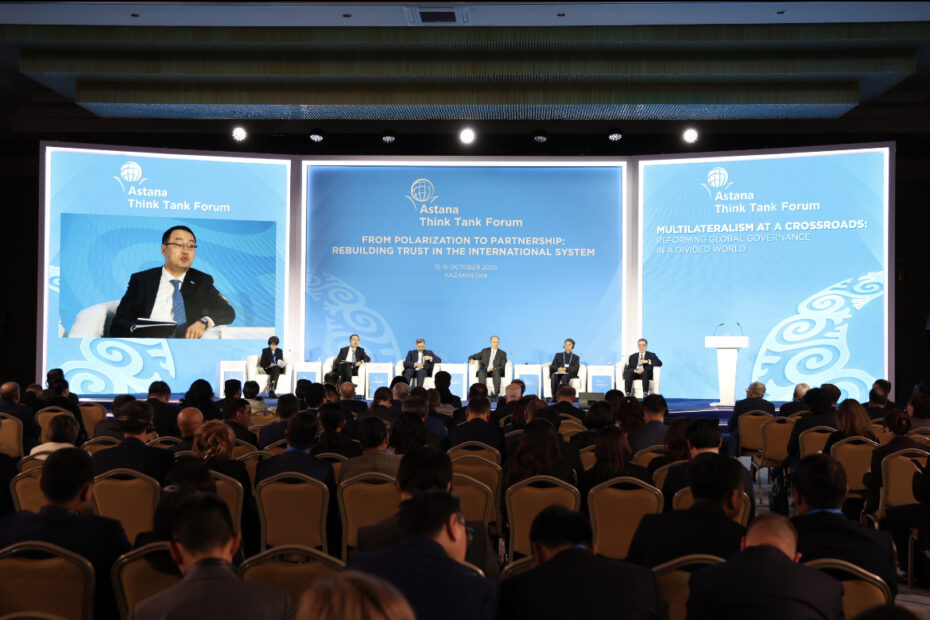
One of the most vivid manifestations of this shift is in Central Asia, where the Kazakhstan Institute for Strategic Studies (KazISS) under the President of Kazakhstan has become a linchpin of regional expert dialogue. KazISS frequently organizes forums, most notably the annual Astana Think Tank Forum which convenes scholars, diplomats, and policymakers from Eurasia and beyond. In October 2025, the Forum was held under the theme “From Polarization to Partnership: Rebuilding Trust in the International System,” spotlighting Central Asia’s role as a “bridge for global dialogue amid growing polarization” (KazISS, 2025). During a panel on regional security, Zhandos Shaimardanov, the Director of KazISS, proposed an “Expert Alliance of Middle Powers” as a permanent intellectual instrument for renewing multilateral governance. This is not only diplomacy by ideas, but state-sponsored knowledge diplomacy where a government think tank acts as both convener and broker of regional trust (KazISS, 2025).
This proliferation of institutionalized expert dialogue is not limited to Kazakhstan. The Central Asian Think Tanks Forum (CATTF), established more recently, is a dedicated dialogue platform across Central Asian countries (PaperLab, 2025). Its aim is to strengthen partnerships among non-profit think tanks, promote democratic values, and facilitate policy-relevant knowledge exchange. The Forum is supported by organizations like CAPS Unlock and has become a regular venue for capacity-building, strategy planning, and peer exchange (CAPS, 2024). Such forums are concrete examples of regional knowledge diplomacy: not ad hoc, but institutionalized, with multi-year commitments to building a shared epistemic infrastructure.
Beyond intra-Central Asia dialogue, cross-border think tank cooperation with major powers has also deepened. In June 2025, Kazakhstani think tanks, including KazISS, co-hosted the Central Asia–China Think Tank Forum together with the Chinese Academy of Social Sciences (CASS) (KazISS, 2025). The Forum emphasized creating a strategic framework for cooperation between Central Asia and China not just on economic corridors, but on long-term regional development. By involving experts from multiple Central Asian states, the initiative channels local knowledge into China’s regional diplomacy, while giving Central Asia a seat in constructing the narrative of its own future.
Similarly, the International Institute for Central Asia (IICA), together with Russia’s Alexander Gorchakov Public Diplomacy Fund, recently organized the “Think Tank Forum Central Asia – Russia: Strategic Partnership in a Changing World” (Uza.uz, 2025). According to Javlon Vakhabov, Director of IICA, such platforms foster expert exchanges on energy, innovation, security areas where both Central Asia and Russia have deep stakes. Through such policy dialogues, regional think tanks are bridging national priorities and turning them into shared intellectual agendas.
This growing ecosystem of knowledge diplomacy is underpinned by the strategic expansion of think tanks across the region. The CAREC Institute (Central Asia Regional Economic Cooperation) hosts the CAREC Think Tanks Network (CTTN), which includes research institutions from eleven countries in the CAREC region (CAREC, n.d). The network was launched at the second CAREC Think Tanks Development Forum in Urumqi, and today it aims to enhance collective intelligence among regional think tanks, develop policy advice, and reduce the gap between research and actual policymaking. In effect, CTTN institutionalizes knowledge flows, not just across states, but between the expert and policy communities making think tanks essential nodes of regional governance.
The Eurasian Research Institute (ERI), based in Almaty as a part of the Khoja Akhmet Yassawi International Kazakh-Turkish University, exemplifies another model of regional epistemic infrastructure. ERI publishes a peer-reviewed Eurasian Research Journal covering economics, history, and international relations across the Eurasian space (ERI, n.d.). By positioning itself at the intersection of academia and policy, ERI functions both as a knowledge producer and a broker: fostering regional understanding among Turkic-speaking states, Russia, China, and beyond.
Of course, not all think tanks are strictly national or state-affiliated. The Institute for Iran-Eurasia Studies (IRAS) in Tehran is a non-governmental, non-profit think tank whose research agenda spans regional cooperation, security, trade, and cultural issues in Eurasia. Through its publications and policy outreach, IRAS plays a dual role: it interprets Iranian perspectives for Eurasian stakeholders, and channels Eurasian analytical debates into Iranian strategic thinking. This kind of two-way knowledge diplomacy helps anchor Iran within Eurasian epistemic networks, giving Tehran intellectual leverage in a region of great geopolitical complexity (Iras, n.d.).
From the Western perspective, think tanks also mediate Eurasian expertise: for example, the Russia/Eurasia Center at IFRI (France) organizes research and debate on Russia, Central Asia, the Caucasus, and Eastern Europe (Ifri, n.d.). Through forums, policy papers, and academic exchanges, the Center helps translate Eurasian policy challenges into European discourse and reflects European policy responses back into Eurasia.
All of this growth in think-tank activity reflects a deeper structural transformation: the recognition that knowledge diplomacy leveraging ideas, expertise, and networks is central to regional order-building. This aligns with how think tanks function more generally. Scholars have long argued that think tanks “bridge the gap between knowledge and policy” by translating complex expertise into actionable advice for governments (Rich et al., 2011). In the Eurasian context, this role is magnified: states with limited institutional capacity often rely on expert centers to aggregate and re-frame policy options, while think tanks gain legitimacy by aligning with state priorities.
Yet, this emerging knowledge ecosystem is not without tensions. In some cases, for instance, think tanks operate in a constrained landscape, where state pressure and discursive control can shape their work. A recent study by Axyonova (2024) examines how Russian think tanks respond to crises, showing that their discursive strategies are closely influenced by political context. This raises the question: to what extent can regional think tanks genuinely act as independent actors, or are they instruments of state policy projection?
Another important dimension is institutional identity. Think tanks in Eurasia are increasingly blurring the lines with universities and research institutes. KazISS, for example, retains strong academic credentials but markets its policy relevance to governments. Scholars have analyzed such hybrid models; Bajenova’s (2016) work shows that think tanks often negotiate their identity by balancing their academic legitimacy with the need for policy influence. This dual identity allows them to engage both as epistemic communities and as diplomatic actors but it also poses sustainability challenges, particularly around funding, governance, and perceived autonomy.
The rise of regional think tanks in Eurasia also occurs against the backdrop of shifting geopolitics. As Central Asian states seek to assert their strategic agency, they deploy think tank diplomacy to escape zero-sum dynamics imposed by great powers. A recent report by the Silk Road Studies Program (Starr & Svante, 2023) argues that Central Asian countries have responded to the influence of Russia and China by creating multilateral expert platforms (like “Central Asia + Japan” and EU dialogue formats), thereby diversifying their diplomatic portfolios. These initiatives are not merely symbolic: they institutionalize agency by embedding trust- and idea-sharing among regional actors.
Furthermore, forums like the Astana Think Tank Forum play both a symbolic and practical role in middle-power diplomacy. In other words, Kazakhstan is cultivating itself as a “middle power of trust,” using its think tank infrastructure to host global discussions and produce policy-relevant knowledge in line with the government’s foreign policy discourse (Shaimardanov, 2025). Through such platforms, Kazakhstan is not only facilitating dialogue, but packaging expertise as a foreign policy tool effectively projecting soft power by convening and producing.
On a theoretical level, the evolution of regional think tanks in Eurasia mirrors global trends: non-state actors increasingly participate in public diplomacy, not just through advocacy but through knowledge production. Scholars of public diplomacy have emphasized that think tanks transform into “alt agents” non-state actors that shape narratives and contribute to foreign policy agendas independently of purely state-led institutions (Bajenova, 2016; Chen and Xu, 2024). The Eurasian case shows this dynamic in practice: think tanks are embedded within state-led diplomacy (e.g., forum hosting) but also maintain epistemic autonomy, contributing to a pluralistic architecture of regional governance.
Yet, their impact should not be overstated. While think tanks convene high-level forums and publish policy briefs, formal institutionalization of their recommendations into binding regional governance remains limited. Unlike intergovernmental organizations, these expert networks lack enforcement power. Their influence tends to be normative and dialogic, rather than legal or coercive. In addition, their sustainability depends heavily on political goodwill and funding from states or external actors exposing them to cyclical risk (Kuandykov, 2025).
In sum, the rise of regional think tanks in Eurasia represents a meaningful shift in how states conduct diplomacy and policy dialogue. Think tanks like KazISS, ERI, IRAS, and networks such as CTTN are not just passive research institutions, they are active agents of knowledge diplomacy. By convening dialogue, producing regional expertise, and bridging local and global actors, they facilitate a more interconnected Eurasian intellectual space. While their independence and long-term influence remain subject to political constraints, their emergence signals the maturation of regional epistemic infrastructure — a soft power axis increasingly central to Eurasian geopolitics.
References
Astana Times (2021). KazISS Ranks First Among Central Asian Institutions in 2020 Global Go to Think Tank Index Report. Retrieved from https://astanatimes.com/2021/02/kaziss-ranks-first-among-central-asian-institutions-in-2020-global-go-to-think-tank-index-report-in-covid-19-response-category/. Accessed on 25.11.2025.
Astana Times (2022). Leading Think Tanks in Central Asia Discuss Regional Agenda for Cooperation in Kazakhstan. Retrieved from https://astanatimes.com/2022/06/leading-think-tanks-in-central-asia-discuss-regional-agenda-for-cooperation-in-kazakhstan/. Accessed on 25.11.2025.
Astana Times (2025). Astana Think Tank Forum Calls for Renewed Trust and Dialogue in Polarized World. Retrieved from https://astanatimes.com/2025/10/astana-think-tank-forum-calls-for-renewed-trust-and-dialogue-in-polarized-world/. Accessed on 26.11.2025.
Axyonova, Vera (2024). Responding to crises in authoritarian environments: Russian think tanks between policy evaluation and state endorsement. Review of Policy Research, 41 (6): 941-960.
Bajenova, Tatyana (2016). Think tanks and universities in the knowledge-based economy: Crossing, blurring and shifting boundaries. New Zealand journal of research on Europe 10 (1): 78-132.
Bajenova, Tatyana (2023). European think tanks as a channel of EU public diplomacy towards transnational publics. Publics and governance 11: 200-212.
CAPS (2024). Think Tank forum. Retrieved from https://capsunlock.org/projects/think-tank-forum/. Accessed on 27.11.2025.
CAREC Institute (n.d.). CAREC Think Tanks Network (CTTN). Retrieved from https://www.carecinstitute.org/carec-think-tank-network/. Accessed on 25.11.2025.
Chen, Peichao, and Yue, Xu (2024). The Role of Think Tanks in the Foreign Affairs Work of the Taiwan Authorities. Chinese Journal of International Review 6 (01): 2450003.
Eurasian Research Institute (ERI) (n.d.). Main page. Retrieved from https://www.eurasian-research.org/. Accessed on 27.11.2025.
Ifri (n.d.). Russia/Eurasia Center. Retrieved from https://www.ifri.org/ru/centre-russieeurasie. Accessed on 26.11.2025.
Kazakhstani Institute for Strategic Studies [KazISS] (2025). Central Asia in Focus: Expert Debates Continue at the Astana Think Tank Forum. Retrieved from https://kisi.kz/en/central-asia-in-focus-expert-debates-continue-at-the-astana-think-tank-forum/. Accessed on 26.11.2025.
Kazakhstani Institute for Strategic Studies [KazISS] (2025). Central Asia–China Think Tank Forum Held in Astana. Retrieved from https://kisi.kz/ru/forum-analiticheskih-chentrov-chentralnoj-azii-i-kitaya-proshel-v-astane/. Accessed on 26.11.2025.
Kuandykov, Tlegen (2025). Think tanks in Central Asia: Inside the sector. Retrieved from https://onthinktanks.org/articles/think-tanks-in-central-asia/. Accessed on 26.11.2025.
Paperlab (2025). Central Asian Think Tanks Forum. Retrieved from https://paperlab.kz/rus/cattf25. Accessed on 27.11.2025.
Rich, A., McGann, J., Weaver, K., Garnett, M., Thunert, M., Speth, R., Traub-Merz, R., & Yang, Y. (2011). Think tanks in policy making–do they matter. Friedrich Ebert Stiftung.
Shaimardanov, Zhandos (2025). Kazakhstan as a middle power of trust. Retrieved from https://emerging-europe.com/opinion/kazakhstan-as-a-middle-power-of-trust/. Accessed on 27.11.2025.
Starr, S. Frederick, and Svante E. Cornell (2023). Stepping up to the “Agency Challenge”: Central Asian Diplomacy in a Time of Troubles. Silk Road Paper, Central Asia-Caucasus Institute & Silk Road Studies Program (July 2023).
The Institute for Iran-Eurasia Studies (IRAS) (n.d.). Main Page. Retrieved from https://www.iras.ir/en/. Accessed on 26.11.2025.
Uza.uz (2025). Think Tank Forum Central Asia–Russia. Retrieved from https://uza.uz/en/posts/think-tank-forum-central-asia-russia-new-impetus-for-strategic-partnership_767708. Accessed on 27.11.2025.
Note: The views expressed in this blog are the author’s own and do not necessarily reflect the Institute’s editorial policy.