Strategic Engagement and Economic Diplomacy: Analyzing President Trump’s October 2025 Visit to Asia
At the end of October 2025, US President Donald Trump embarked on a visit to Malaysia, Japan, and South Korea as part of a broader effort to strengthen the United States’ political and economic engagement in Asia. The main reason for the visit was his participation in the Association of Southeast Asian Nations (ASEAN) and the Asia-Pacific Economic Cooperation (APEC) summits, where he sought to advance US interests in trade, security, and regional cooperation. During these meetings, Trump negotiated several trade arrangements with Asian leaders. This was his first trip to Asia in his second term, and the first visit by a US president to the region since 2023, when the G7 meeting was held (Puri, 2025).
The US President started his trip with a visit to Malaysia on October 26. By the invitation of Malaysian Prime Minister Anwar Ibrahim, he participated in the ASEAN summit and witnessed the signing of the ceasefire agreement between Thailand and Cambodia. The brokering of this agreement is an important event for the United States. This is because Trump contributed to the achievement of a ceasefire between the parties in their prolonged disputes in the summer. For the President, eager to get a Nobel Peace Prize, the participation in the summit was momentous. In addition, during the trip, Trump established trade deals with Malaysia, Thailand and Cambodia, and promised to maintain 19% tariff rates on their exports (Searight, 2025).
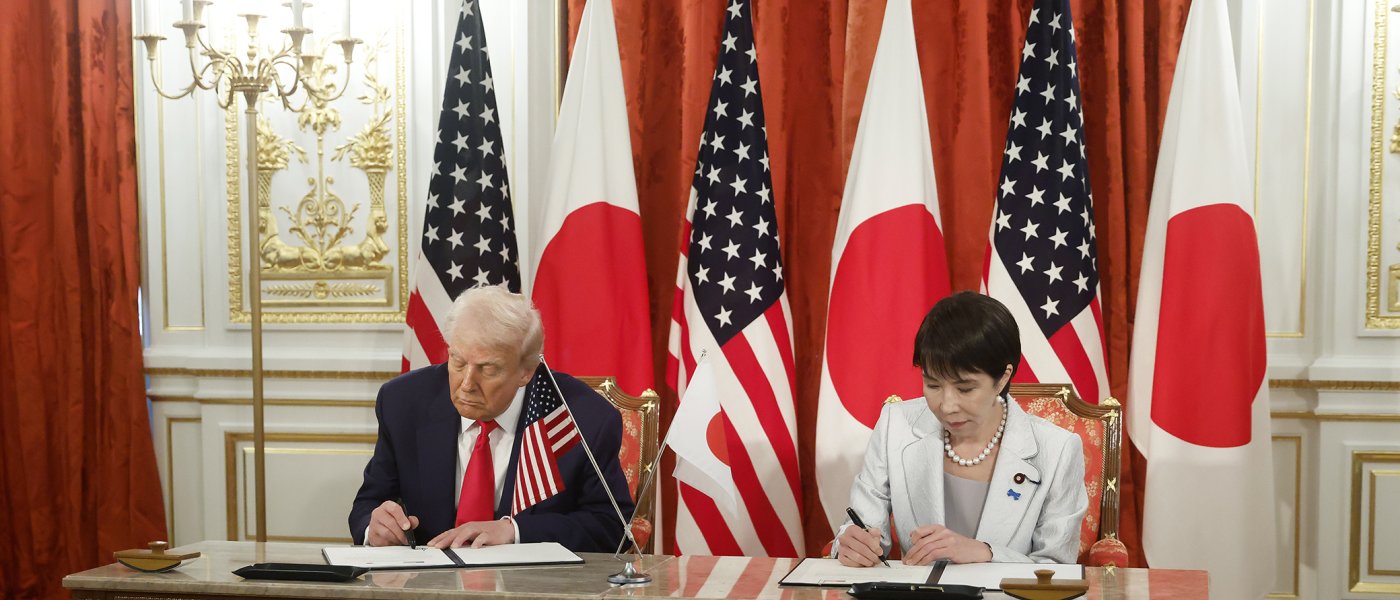
Another visit was to Japan, where Trump also secured trade agreements with the newly elected Prime Minister Sanae Takaichi. According to the agreements, Japan will pour investments into the US economy. In particular, the investments cover the American energy industry, AI infrastructure and electronics, as well as the purchase of Liquefied Natural Gas. In turn, Trump committed to maintaining the tariff rate on Japanese imports at 15% (Wang, Chen, and Maberry, 2025). Following that, in South Korea, Trump achieved a trade deal with President Lee Jae-myung. According to it, South Korea will provide $350 billion in investments to the US economy. Of this amount, $200 billion will be paid in cash, and $150 billion will be invested in the US shipbuilding industry (Hunnicutt, Lee, and Park, 2025). On its part, the US committed to lower tariffs for the South Korean auto industry from 25% to 15% (Wang, Chen, and Maberry, 2025).
Along with establishing trade deals on this trip, the US pursued to strengthen the military capacity of Asian nations by encouraging them to increase their spending on defense. South Korea agreed to raise its military spending on eight percent in the next year, while Japan is planning to spend two percent of its GDP on its defense. Such a high interest of the United States in improving the military potential of Asian states is related to its intention to deter China’s dominance in the region. However, it is obscure whether such an approach will be effective. Even with increasing military spending, the region faces persistent disagreements on military matters. The Asian states’ attitudes towards China’s policy differentiates among them. Even the US allies in Asia have a diverse view of China. As a result, there is a lack of a strong military alliance in Asia that can undermine the US’s aim to decrease China’s influence in the region (Puri, 2025).
Another key area of interest for the US in the Asian region is the joint development of critical mineral resources. Critical minerals have become a crucial topic on the agenda of major economies. Due to their importance in the development of AI infrastructure, electronics, modern defense industries and renewable energy sources, more and more states are getting interested in this field. In particular, the US has prioritized the development of critical minerals. Its interest has significantly grown considering the fact that China is leading the critical minerals supply chain. Therefore, Trump brought up this question during his trip to Japan. On October 27, he achieved an agreement with Japan on critical minerals. It is a significant step for the US, as Japan has developed an efficient system in strengthening the critical minerals industry. Japan’s success is related to the creation and operation of the Japan Organization for Metals and Energy Security (JOGMEC) to manage critical minerals. JOGMEC acknowledged the importance of maintaining the whole supply chain process and therefore diverted investments not only to mining critical minerals, but also to refining and exploration processes. By working together with JOGMEC, the US can strengthen its potential in the supply chain and thus minimize its dependence on China’s exports of critical minerals (Moerenhout, 2025).
The most important part of Trump’s visit was his meeting with President Xi Jinping during the APEC summit in South Korea on October 30. It was the first meeting between the two leaders after Trump’s reelection. In the reality of the trade war between the world’s two largest economies ongoing since the beginning of the year, the meeting was a highly anticipated event to determine the development of these relations. In April, the trade embargo between countries reached its peak, when the US imposed 145% tariffs on Chinese products and China responded reciprocally with 125% tariffs on US exports. After that, the countries were able to achieve some consensus and cut the tariffs, though for a temporary period (Pokatilov, Shoshina, and Prokhorova, 2025). However, in October, China strengthened the control of rare earth elements and put restrictions on the import of US agricultural products, thus provoking US dissatisfaction. Additionally, the countries introduced port fees against each other. Therefore, the meeting between the two leaders at the summit presented an opportunity to solve the trade controversies and achieve a long-term consensus (Czin et al., 2025).
Despite high expectations from the meeting, it did not bring solid outcomes. The countries agreed on temporary terms to improve trade relations. China agreed to halt rare earths export control, remove all retaliatory tariffs, recover the purchase of soybeans from the US and cut off fentanyl supplies (Wang, Chen, and Maberry, 2025). In turn, the US agreed to maintain reduced tariffs on Chinese imports at 24% and reduce tariffs on fentanyl-related goods to 10%. In addition, the United States suspended its recent rule that increased the number of Chinese companies that are prohibited from using American technology (Baskaran and Schwartz, 2025). Both states agreed to halt reciprocal port fees. However, these agreements are set for a one-year period, and what will proceed after that remains uncertain. Another important point in this trade deal is that neither of the parties made major concessions. Most of the commitments made by China were ongoing before the US launch of tariffs in February. It means that the negotiations mainly returned to the status quo without substantial concessions (Kimball, 2025). Despite the limited success of the trade truce, the presidents positively assessed the meeting. Trump marked it 12 out of 10 and pointed out that the deal will last for a long period (Zurcher, 2025).
Overall, Trump’s visit to Asia was productive in improving trade relations with Asian countries. He achieved beneficial agreements in critical minerals, defense, and energy sectors, and promised to maintain tariff rates. The awaited meeting between Trump and Xi Jinping was successful in minimizing the trade embargo. However, Trump was not able to achieve major concessions from China that could significantly strengthen the US position. At the same time, China has also been working to improve its relations with Asian states. Given the United States’ aggressive trade policies, it remains unclear which ally the Asian states will ultimately favor.
References:
Baskaran, Gracelin and Schwartz, Meredith (2025). Ahead of APEC, Trump signs flurry of bilateral minerals agreements on Asia tour. Retrieved from https://www.csis.org/analysis/ahead-apec-trump-signs-flurry-bilateral-minerals-agreements-asia-tour. Accessed on 05.11.2025.
Czin, Jonathan, Felbab‑Brown, Vanda, Hass, Ryan, Kim, Patricia, Kuok, Lynn, O’Hanlon, Michael, Rapp‑Hooper, Mira, Solis, Mireya, Herrera and Yeo, Andrew (2025). What’s at stake during Trump’s visit to Asia. Brookings. Retrieved from https://www.brookings.edu/articles/whats-at-stake-during-trumps-visit-to-asia/. Accessed on 05.11.2025.
Hunnicutt, Trevor, Lee, Jihoon and Park, Ju-min (2025). Trump announces trade breakthrough with South Korea on Asia trip. Reuters. Retrieved from https://www.reuters.com/world/china/trump-heads-south-korea-face-trade-talks-north-korean-missiles-2025-10-28/. Accessed on 07.11.2025.
Kimball, Spencer (2025). The biggest takeaways from the Trump-Xi meeting what the truce covers and what is still unclear. CNBC. Retrieved from https://www.cnbc.com/2025/10/30/trump-xi-south-korea-rare-earth-tariff-trade-war-nvidia.html. Accessed on 07.11.2025.
Moerenhout, Tom (2025). How the US–Japan critical minerals partnership is a long-overdue step toward real supply-chain security. Retrieved from https://www.energypolicy.columbia.edu/how-the-us-japan-critical-minerals-partnership-is-a-long-overdue-step-toward-real-supply-chain-security/. Accessed on 07.11.2025.
Pokatilov, Roman, Shoshina, Sofia and Prokhorova, Svetlana (2025). How the U.S. and China launched a “tariff war”. Retrieved from https://www.rbc.ru/economics/10/04/2025/67f67cb09a794712c50af1c3. Accessed on 08.11.2025.
Puri, Samir (2025). Has Trump’s Asia tour reassured the US’s Asian allies? Retrieved from https://www.chathamhouse.org/2025/11/has-trumps-asia-tour-reassured-uss-asian-allies. Accessed on 17.11.2025.
Searight, Amy (2025). Trump in Southeast Asia: Cease-fire, ceremonies, and the limits of regional diplomacy. Retrieved from https://www.atlanticcouncil.org/blogs/new-atlanticist/trump-in-southeast-asia-cease-fire-ceremonies-and-the-limits-of-regional-diplomacy/. Accessed on 08.11.2025.
Wang, Jonathan, Chen, Henry and Maberry, Scott (2025). Shifts in U.S. Trade in Asia: Key agreements from President Trump’s October 2025 Asia Trip. Retrieved from https://www.globaltradelawblog.com/2025/11/10/shifts-in-u-s-trade-in-asia-key-agreements-from-president-trumps-october-2025-asia-trip-part-i-southeast-asia/. Accessed on 11.11.2025.
Zurcher, Anthony (2025). Trump's Asia tour sees deals, knee-bending and a revealing final meeting. Retrieved from https://www.bbc.com/news/articles/c1j8zn0ex9ro. Accessed on 11.11.2025.
Note: The views expressed in this blog are the author’s own and do not necessarily reflect the Institute’s editorial policy.